Student Profile in development
Academic context, engagement history, flags, referrals, messaging, and coordination in one clearer workspace.
An i3 Initiative
Expanding UConn's beloved student success platform, together.
Nexus is a widely used, deeply valued UConn-built platform. i3 is rebuilding it from the ground up while preserving the workflows, relationships, and institutional knowledge that people across the University depend on every day.
01 / The platform today
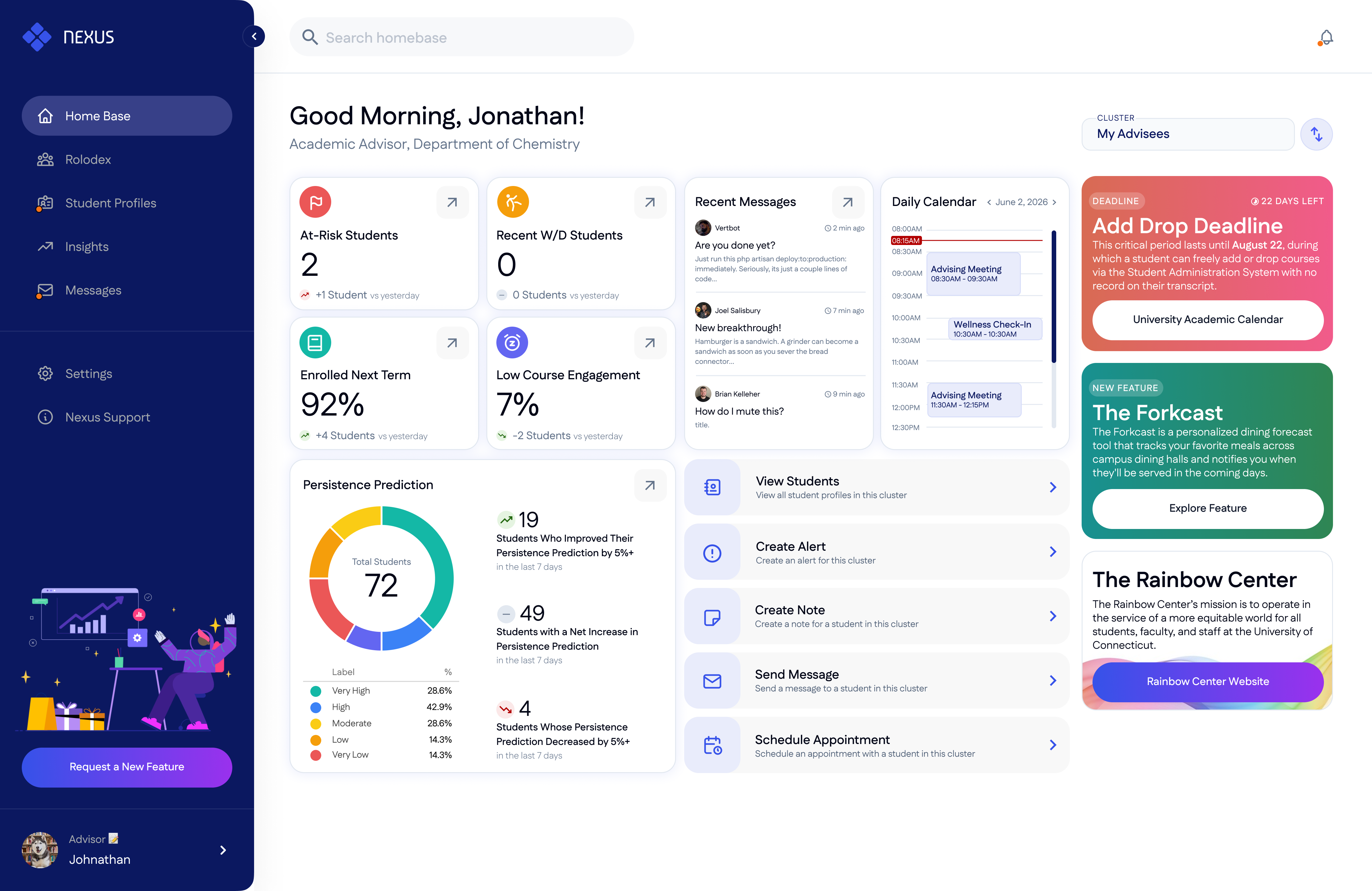
Nexus connects people and information across the University. Advisors, faculty, student-support teams, program staff, and administrators use it to understand a student's experience and coordinate meaningful support.
The platform supports advising and appointments, shared notes, communications, kiosks, events, mentoring, cohort management, student profiles, reporting, and many other workflows. That breadth reflects years of UConn-specific practice and substantial daily use.
Nexus already supports advising, appointments, shared notes, communications, kiosks, events, mentoring, cohort management, tutoring, student-facing tools, reporting, and cross-campus coordination.
02 / Why rebuild
Nexus has grown far beyond the conditions in which it was first designed. Its value is clear, but its original architecture and operating model make it increasingly difficult to improve the experience, connect new data, and respond to changing student-success needs.
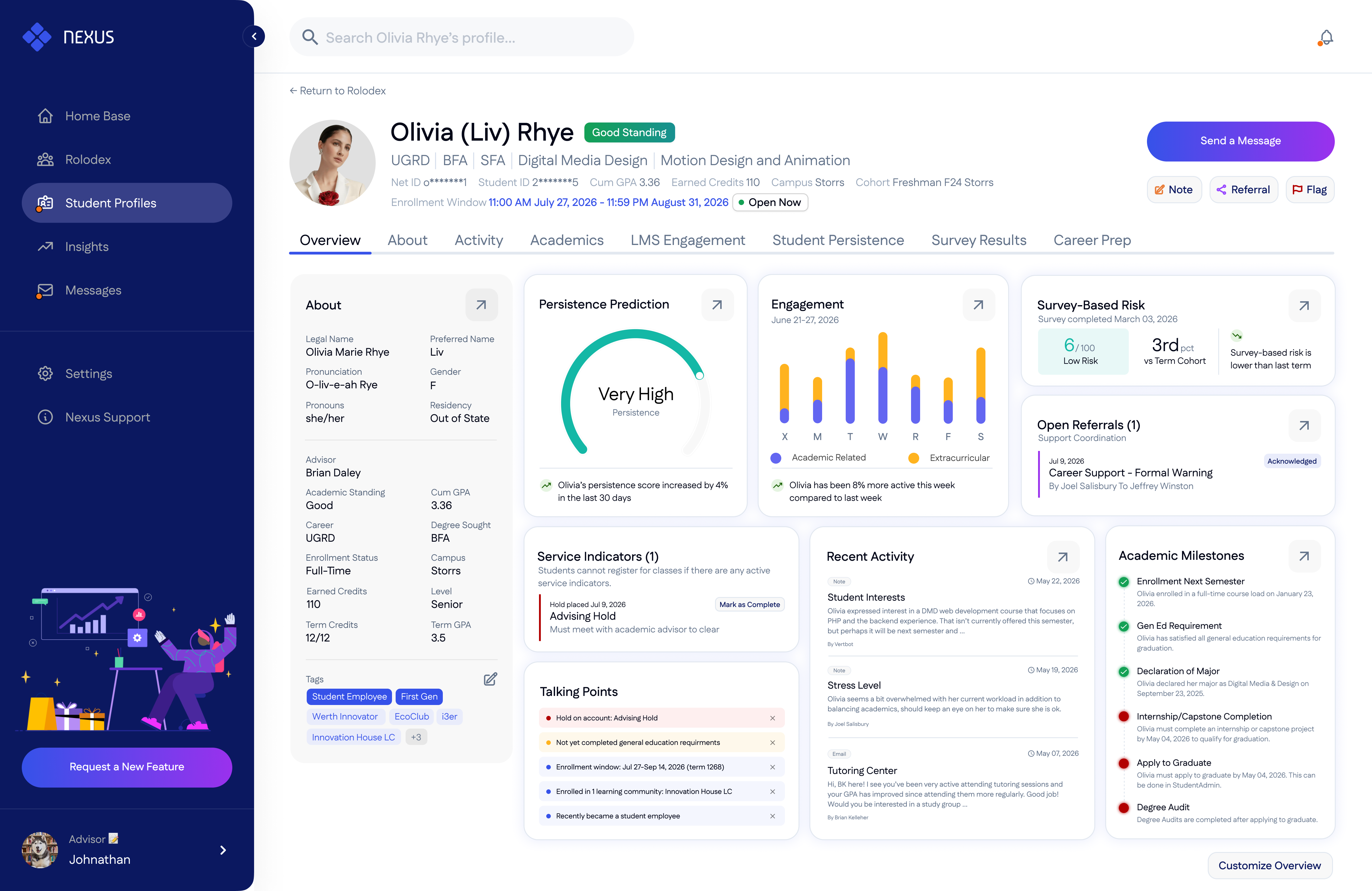
The goal is not to discard a trusted platform. It is to modernize the interface, architecture, integrations, data access, and analytical capabilities while carrying forward the UConn-specific functionality people rely on.
Preserve the UConn-specific capabilities, workflows, and adoption that already make Nexus valuable.
Expand support for advising, student success, faculty, programs, and institutional leadership.
Bring persistence, LMS engagement, survey, and course-pattern insights into one actionable environment.
Strengthen academic context, communications, referrals, coordinated outreach, and follow-through.
A key project principle
New features will be introduced alongside the existing Nexus platform. People will be able to test, adopt, and improve the new experience gradually while the current system continues to support daily work. A full transition will happen only after the new platform has reached sufficient maturity, trust, and adoption.
04 / Work in progress
The rebuild is already producing working product experiences and meaningful new capability, grounded in what the UConn community has asked Nexus to do next.
Project status as of
Academic context, engagement history, flags, referrals, messaging, and coordination in one clearer workspace.
Support for advisors, student-success teams, faculty, programs, and institutional leadership.
Shaped by survey findings, usage data, feature inventories, and ongoing stakeholder interviews.
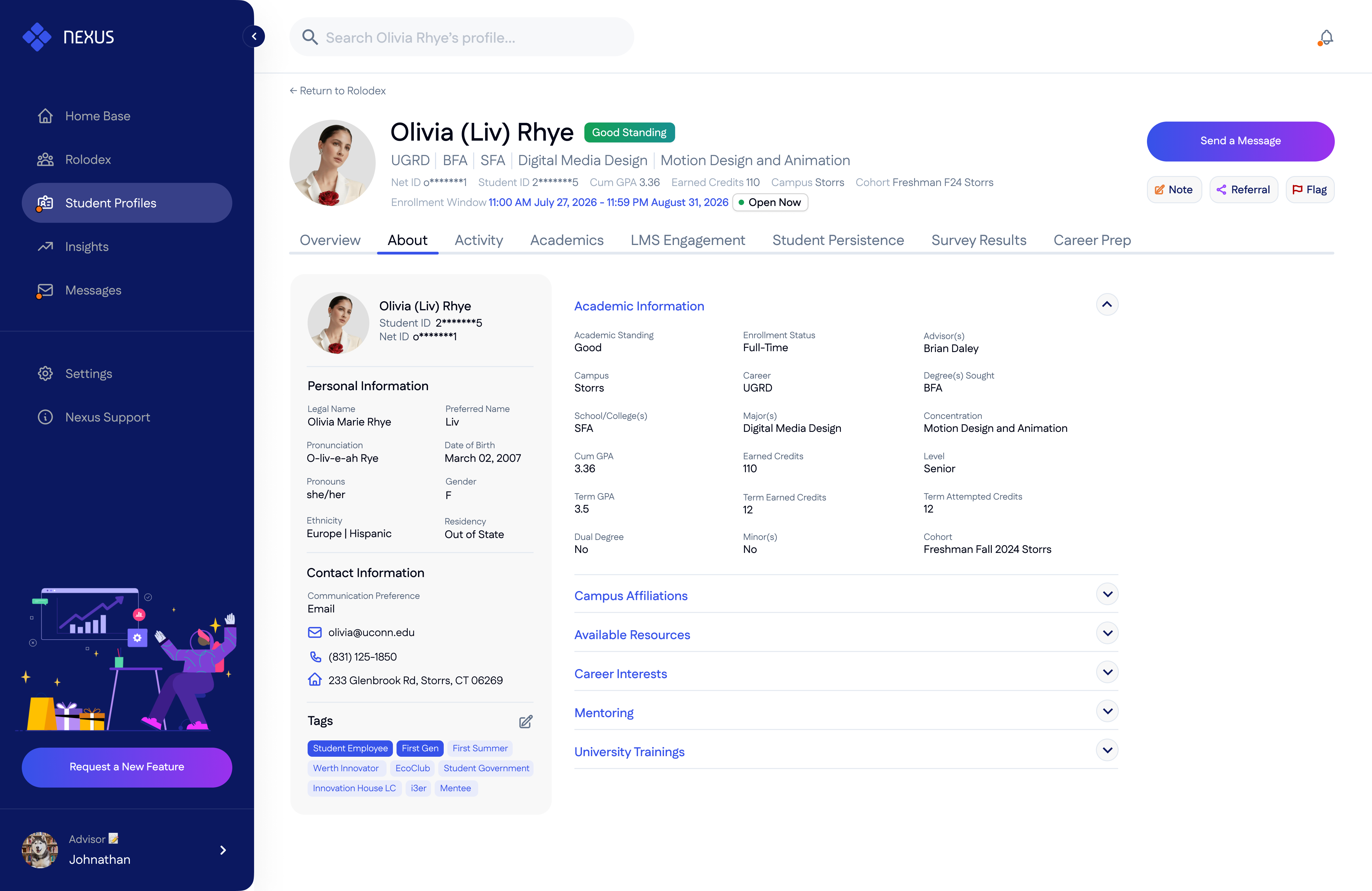
The redesigned profile is more than a visual update. It brings academic information, engagement history, advising context, flags, referrals, messaging, and coordination tools into a more coherent workspace so teams can understand what matters and act with better context.
A major expansion of Nexus
The Insights Hub will provide customizable reporting and student-success intelligence at the institutional, school, college, program, cohort, and individual-student levels. Initial work includes persistence scoring, LMS engagement, survey-based insights, difficult course combinations, and tools for exploring relationships across student data.
Views tailored to different units, populations, and questions.
Persistence, engagement, survey, and academic indicators.
Institutional, school, college, program, and subgroup views.
Tools to identify patterns, test assumptions, and assess interventions.
05 / Direction
The direction is clear: delivery will be incremental, evidence-driven, and grounded in working product experiences.
Develop the Student Profile, Insights Hub, messaging, referrals, academic context, and other core capabilities while the current platform remains fully available.
Introduce usable components to selected groups as they are ready instead of waiting for one large launch.
Use stakeholder interviews, pilot groups, usage data, and direct feedback to refine workflows and validate the product.
Bring more users and units into the new platform as capabilities mature and confidence grows.
Move toward full adoption after the new Nexus reaches sufficient maturity, coverage, trust, and institutional readiness.
06 / Project team
Natalie and Brooke lead the public-facing needfinding work, supported by deep Nexus stewardship, product direction, and technical leadership.

Project co-lead
Needfinding and Stakeholder Engagement
Brooke co-leads stakeholder research and product discovery, organizing outreach, facilitating conversations, and ensuring perspectives from across UConn shape the work.
View Brooke's LinkedIn profile
Technical Lead and Principal Developer
Brian leads the technical architecture and engineering direction for Nexus. He is responsible for turning the product vision into a durable, secure, scalable platform and guiding the development decisions that will shape Nexus for years to come.
View Brian's LinkedIn profile
Project co-lead, UX Design Lead
Needfinding and UX/Product Design
Natalie co-leads stakeholder research and product discovery, translating interviews, workflows, and user feedback into prototypes and the emerging Nexus experience.
View Natalie's LinkedIn profile
i3 Director, Product Direction and Development
Joel helps guide Nexus product direction and priorities while contributing directly to architecture and development.
View Joel's LinkedIn profile
Creator and Steward of Nexus
Jeff created and has guided Nexus through years of growth across UConn. His institutional knowledge, data discovery history, lessons learned, and understanding of how people use the platform are foundational to the rebuild.
07–08 / Feature roadmap
Sign in with your NetID to view the platform capability overview, requested features, and current roadmap status.
Log in with NetIDShape what comes next