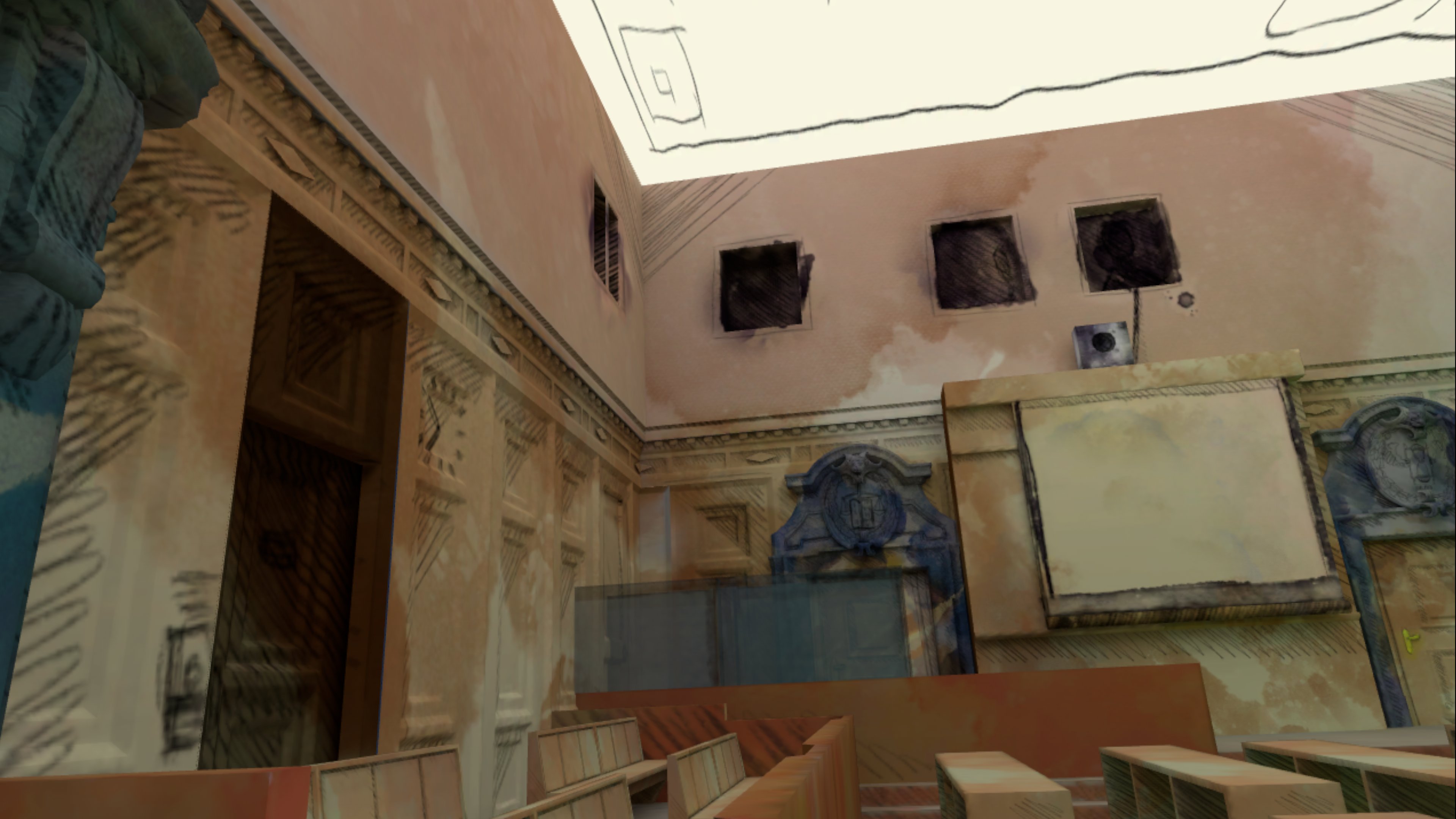
Beyond Nuremberg is an interactive, headset-based virtual reality (VR) game in which players join a time-travel research team. Armed with a chronogeometer, the tech that makes jumping to past times and places possible, they visit historic sites, search for artifacts, and collect clues to analyze back in the Archives. The first chapter, "Mission: Ukraine," connects Nazi war crimes tried in 1945–46 before the International Military Tribunal (IMT) in Nuremberg, Germany, to the Jewish community of Tuchyn, Ukraine. The defendants' box in Courtroom 600, rendered in a style inspired by courtroom sketches from the Trial of the Major War Criminals at Nuremberg, 1945–46.The Tuchyn Story The journey begins in Courtroom 600 of Nuremberg's Palace of Justice, where the trial of Nazi war criminals is underway. Successfully collecting and examining clues unlocks new destinations. The player decides which trail to follow next. One path leads back in time and east to Tuchyn, a town where 3,000 Jews lived and raised families under Nazi occupation. Players explore a garment factory where a spool of thread, a crust of bread, and other ordinary objects reveal individual lives. They meet survivor Herman Wajcman, whose testimony teaches players about forced labor, persecution, and the armed uprising that the Jewish community mounted in 1942. The unfolding story connects individual experiences to the administrative machinery of genocide as overseen by IMT defendant Alfred Rosenberg, the Nazi official responsible for the Occupied Eastern Territories. This progression links legal accountability with lived experience, foregrounding Jewish lives, agency, and testimony.
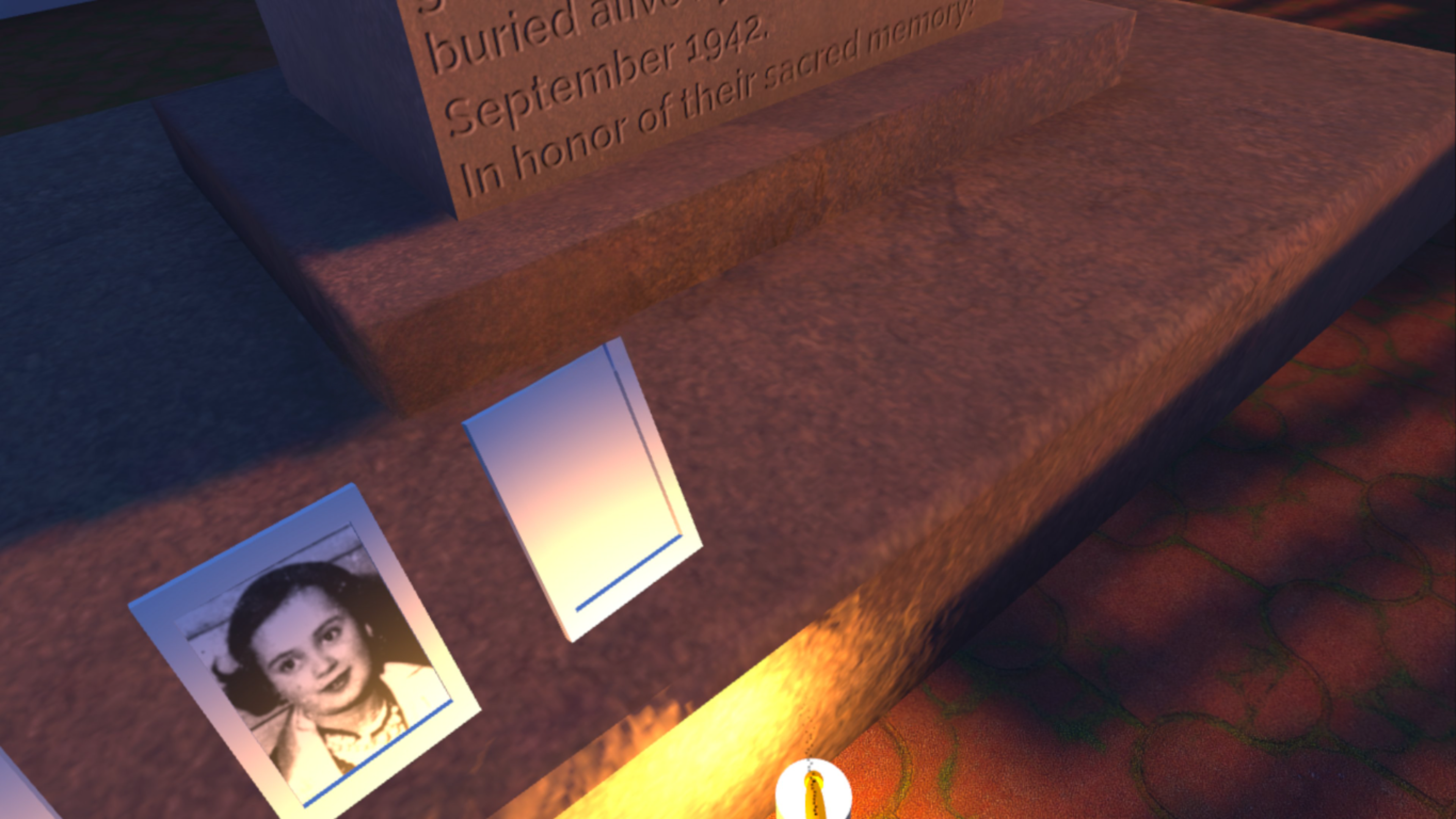
Detail of the present-day Holocaust memorial in Tuchyn, Ukraine, recreated using 3D photogrammetry of the monument and environs.The game's journey culminates at the Holocaust memorial in present-day Tuchyn, where the player lights candles to illuminate the monument. Through photographs laid at its base, they encounter familiar names and new ones among the honored dead, including Paula Wajcman, Herman’s sister. Each name is specific. Each life is particular. A Mission Report at the close of the experience connects players to museums, archives, and other repositories where they can continue exploring the primary sources and history they encountered in the game.
Sharpening Critical Thinking
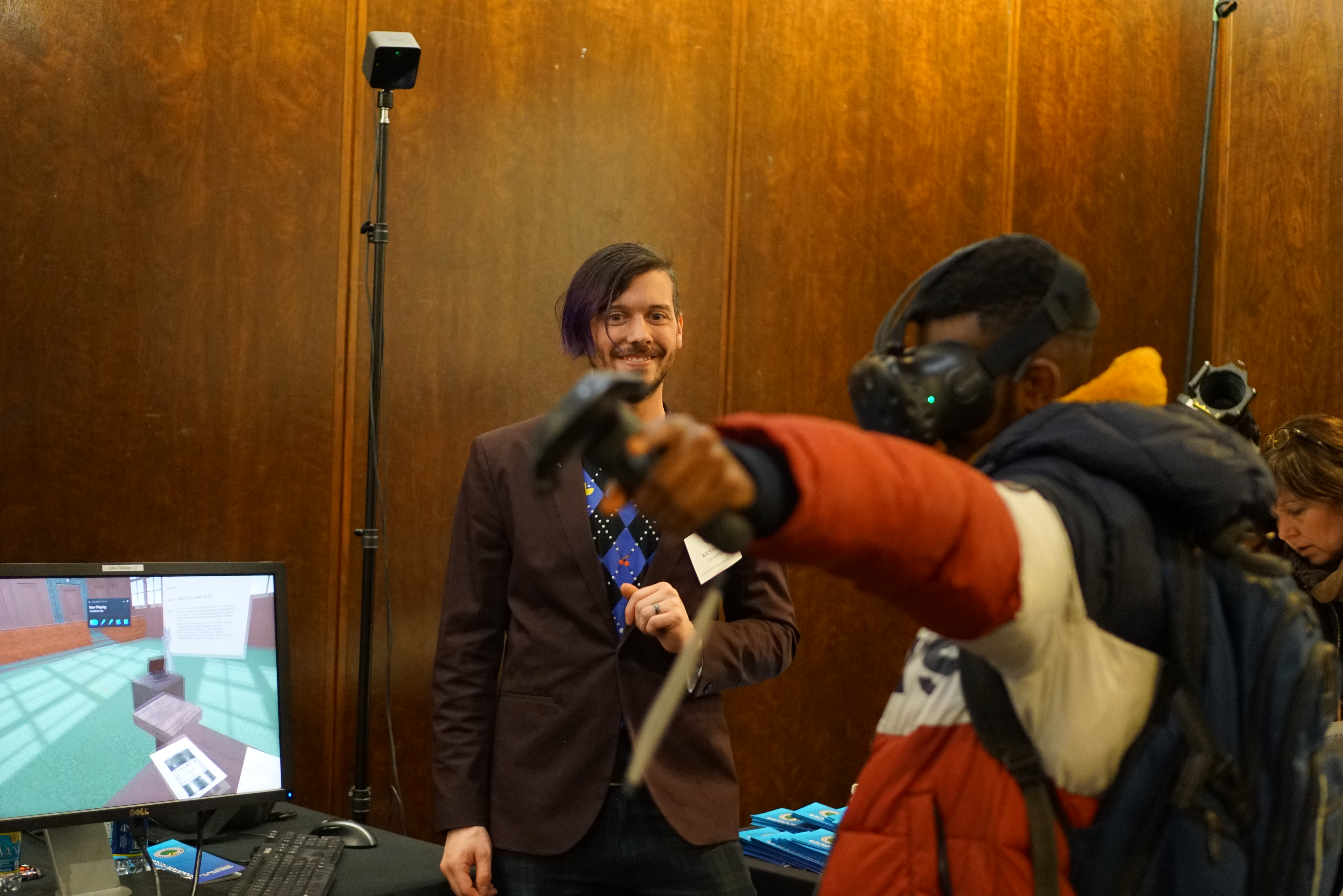
An attendee at ED Games Expo investigates objects in the courtroom as they explore an early proof-of-concept build.Analyzing clues is not only how the story unfolds; it is also how players build skills. Question-and-answer sequences guide players as they examine court documents, photographs, oral testimonies, and other primary sources drawn from Holocaust museums and archives. As players progress, the game grows more demanding. Not everything they encounter is what it appears.Some historic sources are intentional instruments of deception: propaganda that presents dehumanizing falsehoods as fact. Players must learn to identify not just what these documents say, but what they are and what they did. A second category is more unsettling: modern-day forgeries planted in the past by another time traveler. An alert from the team’s equipment signals when something is amiss in the environment. How and why these fakes got to the past is a mystery the player must help solve. Distinguishing period propaganda from faked history builds players' ability to evaluate evidence and assess its validity—timely skills in an age of digital disinformation.
Beyond Nuremberg's mission is to foster awareness of the human impacts and legacies of the Holocaust for a new generation. Recent studies show that broad cultural knowledge of the Holocaust is declining among younger Americans even as misinformation and denial, including denial of the evidence presented at Nuremberg, continue to proliferate online. The game is designed to engage the 18- to 34-year-olds who are among the 158.6 million U.S. adults (60% of the adult population) who currently play video games. Complex narratives that unfold across time and space, rewarding gradual mastery of new skills, are central to this project. They are also features valued by the story-driven players we aim to reach.Building the Game, Advancing the Field
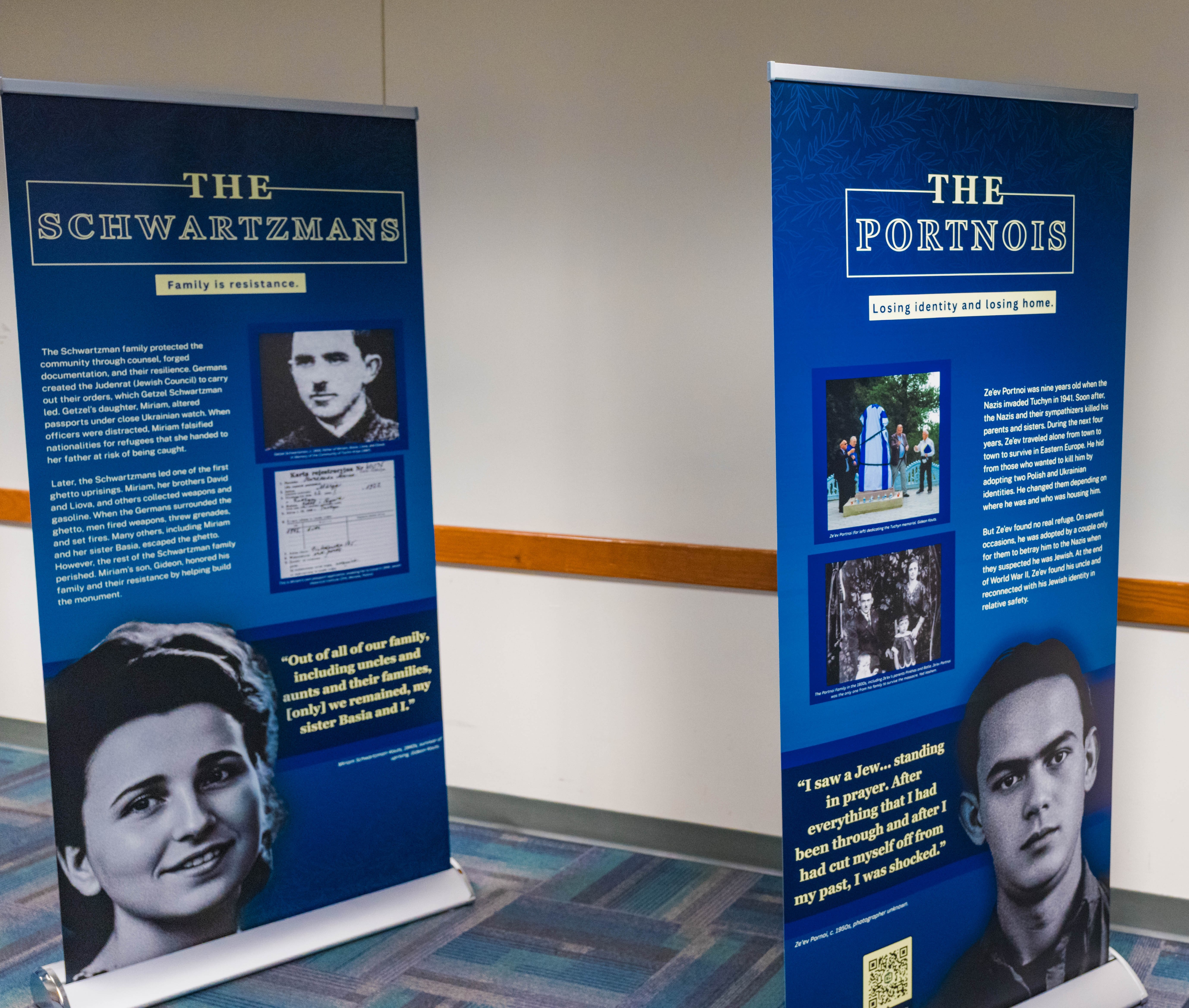
Etched in Stone is a pop-up exhibit about Tuchyn's Jewish community developed by UNC Greensboro researchers. It enriches current playtesting and points to the deep historical research shaping the game.Beyond Nuremberg is being developed by an interdisciplinary team of faculty, developers, designers, and other talents working at the University of Connecticut and the University of North Carolina Greensboro. The game is designed for MetaQuest 3 and Vive Pro headsets and built for 3–5 hours of single-player engagement. The team is currently constructing a full playable build of “Mission: Ukraine,” with formative assessments guiding ongoing iteration to ensure the game meets its core goals: building historical knowledge, developing critical thinking skills, and fostering sustained engagement with Holocaust history. As part of that work, the team is developing the Archive Access Plug-in, new open-source software that allows materials held in online repositories to be rendered and handled in Unity3D environments. The plug-in addresses a technical gap to better allow the use of archival primary sources in VR environments. It will be freely available to others working at the intersection of public history and immersive media.
Development of Beyond Nuremberg is supported by a National Endowment for the Humanities Digital Projects for the Public Discovery Grant, a University of Connecticut Research Excellence Program Award, and a School of Fine Arts Dean’s Grant; funding from The Dodd Center and the UConn Office of Global Affairs, and a UNC Greensboro Internal Research Award.
Vos, R., & Stolk, S. (2022). "Courtroom 600: The (Virtual) Reality of Being There." International Criminal Law Review, 22(1-2), 308-327. https://doi.org/10.1163/15718123-bja10090
Ken Thompson / Assistant Professor, Digital Media and Design Department, UConn
Clarissa J. Ceglio / Associate Director of Collaborative Research, UConn Humanities Institute and Associate Professor of Digital Public History, Digital Media and Design Department, and Department of History
Anne Parsons / Director of Public History, Department of History, Jewish Studies, and Women, Gender, and Sexuality Studies at UNC Greensboro
John W. Borchert / Director, ARCADE (Applied Research in Computer Arts, Digitization, and Esports) at UNC Greensboro